
Feb . 24, 2026 10:55 Back to list
Understanding the Theoretical Freezing Point of Glacial Acetic Acid and Its Implications
Understanding the Theoretical Freezing Point of Glacial Acetic Acid
Glacial acetic acid, a highly concentrated form of acetic acid (typically 99% or greater), is a vital chemical in numerous industrial applications. Understanding its physical properties, including its theoretical freezing point, is crucial for safe handling, storage, and utilization. This article will delve into the factors influencing this point, its practical implications, and relevant considerations for those working with this chemical. Accurate knowledge of this property is key to preventing solidification issues and maintaining operational efficiency.
What is Glacial Acetic Acid?
"Glacial" refers to the fact that acetic acid crystallizes at a relatively high temperature for most acids – close to room temperature. This term originated historically when early purifications resulted in the acid solidifying, resembling a glacier. It's important to note that glacial acetic acid is not ice! It’s a corrosive liquid with a pungent odor and is widely used in the production of various compounds, including vinyl acetate monomer (VAM), acetic anhydride, and cellulose acetate. Furthermore, it functions as a solvent, a food preservative, and a key component in numerous chemical processes.
Factors Influencing the Theoretical Freezing Point of Glacial Acetic Acid
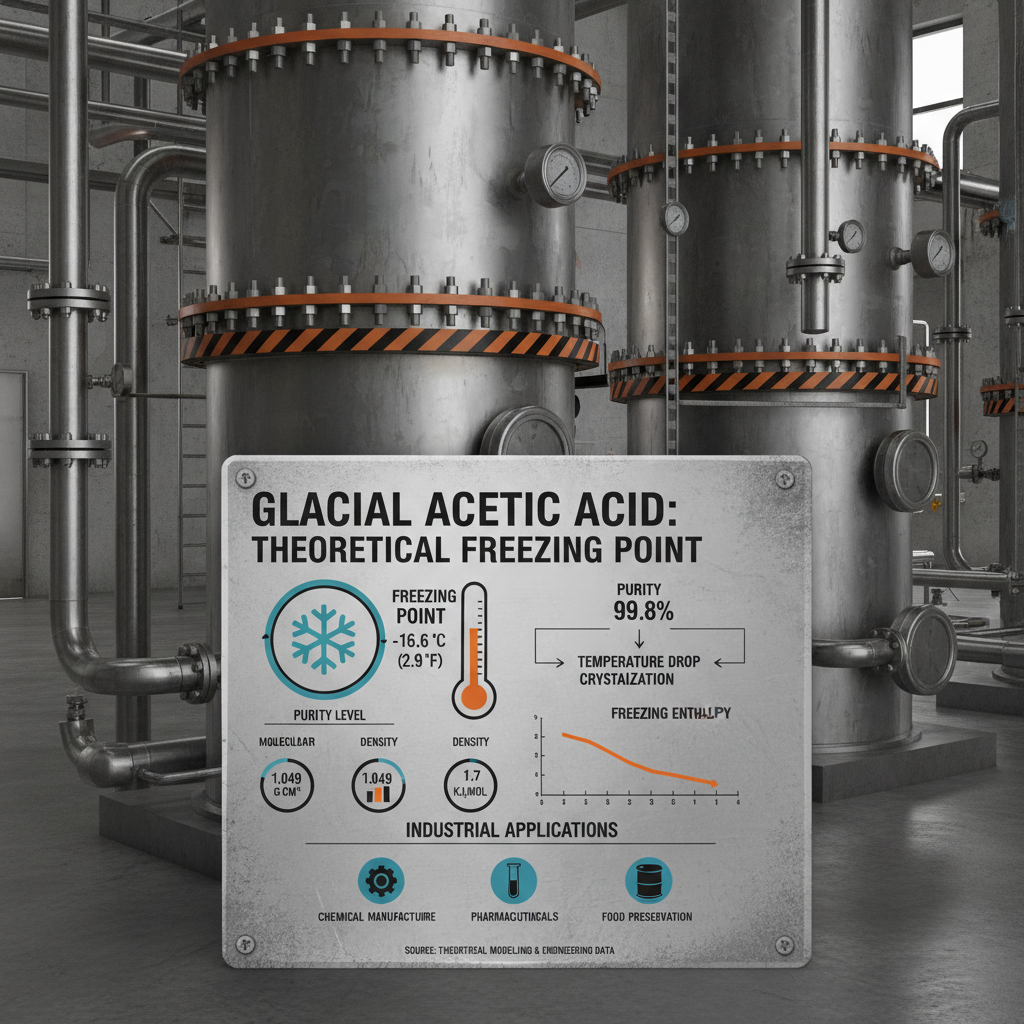
The theoretical freezing point of pure glacial acetic acid is approximately 16.6 °C (61.9 °F). However, this value can be influenced by several factors. The most significant is the presence of impurities. Even small amounts of water or other chemicals can lower the freezing point, a phenomenon known as freezing point depression. Furthermore, the rate of cooling affects the observed freezing point. Supercooling, where the liquid remains below its freezing point without solidifying, can occur, especially with rapid cooling. Pressure also plays a role, albeit a minor one, affecting the freezing point slightly. Understanding these factors is crucial for accurate temperature control during storage and transport.
Key Influences: Impurities, cooling rate, and pressure all affect the observed freezing point. Maintaining high purity is essential for consistent behavior.
The Impact of Impurities on the Freezing Point
As mentioned earlier, impurities significantly impact the freezing point. Water is a common contaminant and its presence demonstrably lowers the freezing point of glacial acetic acid. The extent of the depression depends on the concentration of water. The addition of other organic compounds will also have a similar effect, although the magnitude will vary depending on the compound's nature. This is why it’s critical to maintain the purity of glacial acetic acid, especially in applications where precise temperature control is required. YSXL Glacial Acetic Acid is known for its high purity, minimizing these concerns.
Freezing Point Depression:
• Water is a common impurity.
• The extent of depression depends on concentration.
• High purity acetic acid minimizes this effect.
Comparing Freezing Points: Pure vs. Impure Glacial Acetic Acid
To illustrate the effect of impurities, consider the following table comparing the freezing points of pure and impure glacial acetic acid. These values are approximate and will vary depending on the specific impurities and their concentrations.
Practical Implications and Handling Considerations
Understanding the theoretical freezing point of glacial acetic acid has significant practical implications. During transportation and storage, particularly in colder climates, measures must be taken to prevent solidification. This may involve heating the containers or utilizing insulated tanks. Solidification can cause expansion, potentially leading to container damage. Furthermore, thawing solidified acetic acid requires careful control to avoid localized overheating and potential hazards. Always consult the Material Safety Data Sheet (MSDS) for specific handling and storage instructions.
Conclusion: Managing Glacial Acetic Acid Temperature
Maintaining proper temperature control is crucial when working with glacial acetic acid. Recognizing the factors influencing its freezing point, the impact of impurities, and employing appropriate handling procedures are essential for safe and efficient operations. YSXL Glacial Acetic Acid provides a high-quality product with consistent specifications, contributing to reliable performance.
Frequently Asked Questions (FAQs)
What should I do if my glacial acetic acid solidifies?
If glacial acetic acid solidifies, do not attempt to heat it directly with an open flame. Instead, use a controlled heating method, such as a warm water bath, to gently thaw the material. Monitor the temperature carefully to avoid localized overheating, which can cause decomposition and potentially release hazardous fumes. Ensure adequate ventilation during the thawing process. Once thawed, thoroughly mix the acetic acid to ensure homogeneity before use. It's best to prevent solidification in the first place by maintaining proper storage temperatures.
How can I prevent glacial acetic acid from freezing during transport?
Several methods can prevent freezing during transport. Insulated containers are effective in minimizing heat loss. For longer distances or colder climates, heated containers or tank trucks may be necessary. Regularly monitoring the temperature of the acetic acid during transport is crucial. Proper packaging and labeling are also essential to ensure safe handling. The specific method chosen will depend on the duration of transport, the ambient temperature, and the quantity of acetic acid being shipped.
What is the effect of different types of impurities on the freezing point?
Different impurities will depress the freezing point to varying degrees. Water has a relatively predictable effect, and its concentration can be correlated to the freezing point depression. Other organic compounds, such as alcohols or other carboxylic acids, will also lower the freezing point, but the extent of the depression will depend on their chemical properties and concentration. Metallic ions can also act as impurities and affect the freezing point, although to a lesser extent. Accurate analysis of the impurity profile is necessary to predict the freezing point accurately.
-
Industrial Applications and Properties of 75 acetic acid Solution
NewsApr.16,2026
-
Properties and Industrial Applications of 64 19 7 acetic acid
NewsApr.09,2026
-
Comprehensive Guide to 56 Acetic Acid Applications and Reliable Sourcing
NewsApr.07,2026
-
Comprehensive Guide to 5 Glacial Acetic Acid for International Trade and Industrial Applications
NewsApr.04,2026
-
Exploring 100 Acetic Acid Properties Applications and Reliable Sourcing
NewsMar.31,2026
-
Comprehensive Guide to 10 Glacial Acetic Acid Properties and Applications
NewsMar.28,2026
 English
  Belarusian
  Dutch
Dutch  French
  German
  Hindi
Hindi  Indonesian
  Japanese
  Korean
  Lao
Lao  Malay
Malay  Mongolian
  Myanmar
  Polish
  Portuguese
  Russian
  Spanish
  Tagalog
  Thai
Thai  Vietnamese