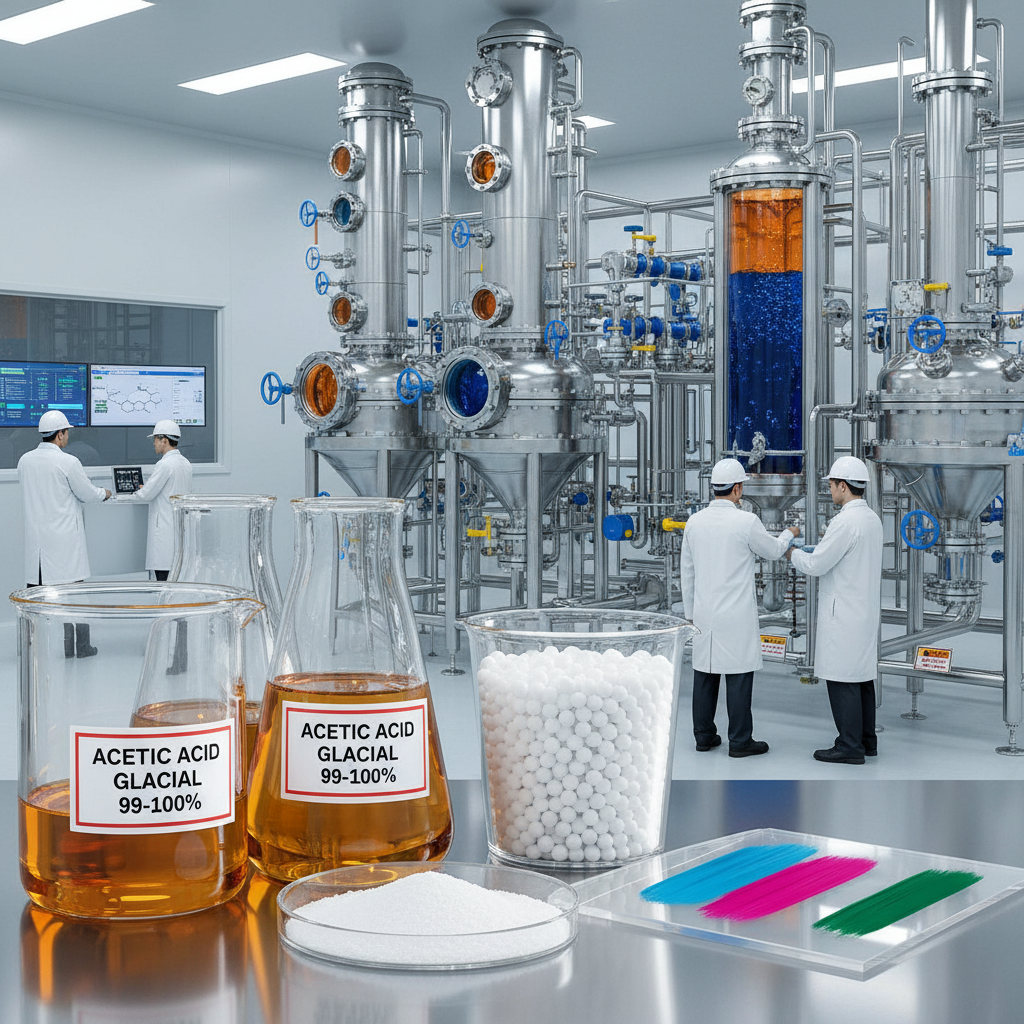
Achieving the precise balance of acidity in commercial food production often depends on the purity and consistency of the raw materials used. For manufacturers seeking a reliable source of high-concentration acetic acid, navigating the options for oem acetic acid glacial is critical to maintaining product stability and flavor profiles.
The shift toward standardized food additives has increased the demand for "glacial" grades—those with concentrations typically exceeding 99.8%. This purity level is essential not only for flavor consistency but also for meeting strict regulatory requirements for acidity regulators, such as the E260 specification in the global food additive list.
This report examines the technical specifications of food-grade glacial acetic acid, its diverse applications across the food manufacturing sector, and the operational factors that determine a successful OEM partnership for chemical sourcing.


Acetic acid, with the molecular formula CH3COOH, is a typical fatty acid organic compound widely present in nature. In its anhydrous form, it is referred to as "glacial" acetic acid because it forms ice-like crystals at temperatures below 16.6°C, a physical property that defines its handling and storage requirements in industrial settings.
For the food industry, this high-concentration form serves as the precursor to various edible vinegars and seasoning solutions. Its stimulating odor and colorless liquid appearance are hallmarks of its purity, provided the content remains above the 99.8% threshold required for professional food additive standards.
Precision in food manufacturing requires strict adherence to physical and chemical indicators. Edible glacial acetic acid is characterized by a boiling point of 117.9°C and a relative density of 1.0492. These metrics, combined with a refractive index of 1.3716, allow quality control teams to verify the authenticity and concentration of the batch before it enters the production line.
The purity level (content ≥ 99.8%) is the most critical metric. Any significant deviation can introduce impurities that affect the taste, color, or shelf-life of the final food product. In an OEM context, this requires rigorous batch testing to ensure that every shipment meets the specified purity levels without variance.
Furthermore, the managing of the melting point (16.6°C) is a logistical necessity. Facilities must be equipped to handle the substance in both liquid and semi-solid states, depending on the seasonal ambient temperature, ensuring that the delivery of the additive remains fluid and injectable into mixing tanks.
Beyond flavor, the primary function of acetic acid in the food industry is its role as a specified acidity regulator (E260). By lowering the pH level of a food product, it inhibits the growth of pathogenic microorganisms and extends the shelf life of perishable goods.
Maintaining a consistent pH threshold is not merely about taste; it is a critical safety barrier in food preservation that prevents spoilage and ensures consumer health across diverse product categories.
When used in canned goods, such as tomatoes or asparagus, the acidulant acts as a stabilizer. The ability to dilute glacial acetic acid precisely—often to a 4-5% concentration for edible vinegar—allows manufacturers to create a controlled environment that mimics the flavor of brewed vinegar while maintaining industrial-scale efficiency.
Evaluating the suitability of an acidulant involves weighing several qualitative and quantitative factors. The "Value Index" of an additive is typically measured by its purity, ease of dilution, sensory impact, and regulatory compliance. High-grade glacial acetic acid scores highly across these dimensions due to its versatility.
For an OEM partner, the ability to provide consistent technical performance is more valuable than a low unit price. A manufacturer's capacity to maintain the ≥ 99.8% purity standard ensures that the end-product—whether it be mayonnaise or baby food—remains chemically stable.
The application spectrum for edible glacial acetic acid is remarkably broad. In the production of compound seasonings and sauces—such as tomato sauce, mayonnaise, and rice sugar sauce—it acts as both a flavor enhancer and a preservative. Its ability to provide a sharp, clean sourness makes it an ideal choice for kimchi and various types of cheese.
Beyond savory products, diluted acetic acid is used in the confectionary and beverage sectors. When properly diluted, it serves as an acid flavoring agent in soft drinks, candies, baked goods, and puddings. Its versatility allows it to transition from a heavy-duty preservative in canned sardines and squid to a subtle taste modifier in gum and soft drinks.
Selecting an OEM partner for glacial acetic acid requires a focus on supply chain reliability and quality assurance. Because food-grade materials must adhere to strict purity levels, the manufacturer's ability to maintain a consistent batch-to-batch profile is the primary differentiator.
Hebei Yishan Flavor Co., Ltd. exemplifies this approach by focusing on the production and sale of edible acetic acid with a commitment to contractual integrity and long-term cooperation. For a manufacturer, partnering with an entity that values credit and recognizes the criticality of food-grade specifications reduces the risk of production downtime and regulatory non-compliance.
The decision-making process should not only consider the chemical specifications but also the openness of the supplier to discuss tailored development plans. This collaborative approach ensures that the acidulant's purity and concentration are perfectly aligned with the specific needs of the final food application.
When choosing between different acidity regulators, manufacturers must weigh the sensory profile against the technical requirements of the product. Glacial acetic acid provides a distinct, stimulating odor and sharp taste that is essential for vinegar-based products but may need careful dilution for delicate sweets.
The trade-off usually involves the balance between concentration and handling safety. While glacial grades offer the highest efficiency and lowest shipping volume per unit of active acid, they require specialized handling equipment compared to pre-diluted solutions.
The following framework provides a comparative view of how glacial acetic acid performs against common industry requirements across various food production scenarios.
| Evaluation Factor | Glacial Acetic Acid | Brewed Vinegar | Citric Acid | Lactic Acid |
|---|---|---|---|---|
| Purity Level | ≥ 99.8% | 4-6% | High | Moderate |
| Flavor Profile | Sharp/Clean | Complex/Organic | Bright/Citrus | Mild/Creamy |
| Handling Requirement | Specialized/Cold | Standard | Dry Powder | Liquid |
| Primary Function | Regulator/Preservative | Flavoring | Acidulant | Fermentation/pH |
| Dilution Flexibility | Very High | Low | Moderate | Moderate |
| Regulatory Code | E260 | Natural | E330 | E270 |
In a food-grade context, "glacial" refers to the anhydrous form of acetic acid with a purity typically ≥ 99.8%. It is called glacial because it freezes into ice-like crystals at temperatures below 16.6°C. This high concentration allows manufacturers to use it as a precise starting material for producing edible vinegars or as a concentrated acidity regulator (E260) in various food additives.
To produce edible vinegar, food-grade glacial acetic acid is diluted with water to a concentration of approximately 4-5%. Various seasonings and flavorings are then added to this solution to achieve a taste profile similar to traditional brewed vinegar. This method provides a cost-effective and consistent alternative for large-scale production of condiments like tomato sauce or kimchi.
Due to its high concentration (≥ 99.8%) and irritating odor, glacial acetic acid must be handled with caution. It is corrosive in its concentrated form and requires appropriate personal protective equipment (PPE). Additionally, because it solidifies below 16.6°C, storage facilities must be managed to prevent crystallization or to provide controlled heating for liquid transfer.
While both are used for pH control, glacial acetic acid (E260) provides a sharp, pungent sourness characteristic of vinegar, making it ideal for pickles and savory sauces. Citric acid (E330) offers a brighter, citrus-like flavor preferred in candies and soft drinks. From a preservation standpoint, acetic acid is often more effective in inhibiting specific types of spoilage bacteria in fermented or canned vegetables.
The primary indicator is the content percentage, which should be ≥ 99.8%. Other critical physical parameters include the melting point (16.6°C), boiling point (117.9°C), relative density (1.0492), and refractive index (1.3716). Verifying these metrics ensures that the product is pure, free from contaminants, and will perform predictably during the dilution and mixing processes.
Yes, food-grade glacial acetic acid can be used in baby food, provided it is properly diluted to safe levels. Its role is typically as an acidity regulator and preservative. However, it must meet strict edible ice acetic acid standards to ensure no industrial impurities are present, making the choice of a certified OEM supplier paramount for health-sensitive applications.
The integration of oem acetic acid glacial into food manufacturing streamlines the process of pH regulation and flavor enhancement. By leveraging a high-purity (≥ 99.8%) starting material, producers can ensure that their products—from condiments to soft drinks—remain safe, stable, and consistent in taste.
Ultimately, the success of utilizing this potent additive lies in the precision of dilution and the reliability of the sourcing partner. Companies like Hebei Yishan Flavor Co., Ltd. provide the necessary technical consistency and professional integrity required to maintain high standards in the global food additive market.