
Feb . 26, 2026 02:10 Back to list
Understanding the Solubility of Glacial Acetic Acid in Water and its Applications
Solubility of Glacial Acetic Acid in Water: A Comprehensive Guide
Understanding the solubility of glacial acetic acid in water is crucial for various applications across industries, from chemical manufacturing to laboratory research. Glacial acetic acid, being a highly concentrated form of acetic acid, exhibits unique solubility characteristics. This article delves into the factors influencing this solubility, provides data on its behavior at different temperatures, and highlights its practical implications. We will explore how varying conditions affect its miscibility and what this means for its safe and effective use.
What is Glacial Acetic Acid?
Glacial acetic acid is a concentrated solution of acetic acid (CH₃COOH) containing a minimal amount of water. The term “glacial” originates from its early purification method, where it was cooled to induce crystallization, leaving behind a highly pure, ice-like solid. Typically, glacial acetic acid contains around 99.5-100% acetic acid. Its high acidity and strong odor make it a potent chemical reagent. It’s widely utilized as a solvent, reagent in organic synthesis, and as a precursor in the production of various acetate compounds. YSXL Glacial Acetic Acid provides high-quality glacial acetic acid for diverse industrial needs.
Key Properties: Highly concentrated acetic acid, minimal water content, strong acidity, versatile solvent, widely used in chemical synthesis.
Solubility of Glacial Acetic Acid in Water: The Fundamentals
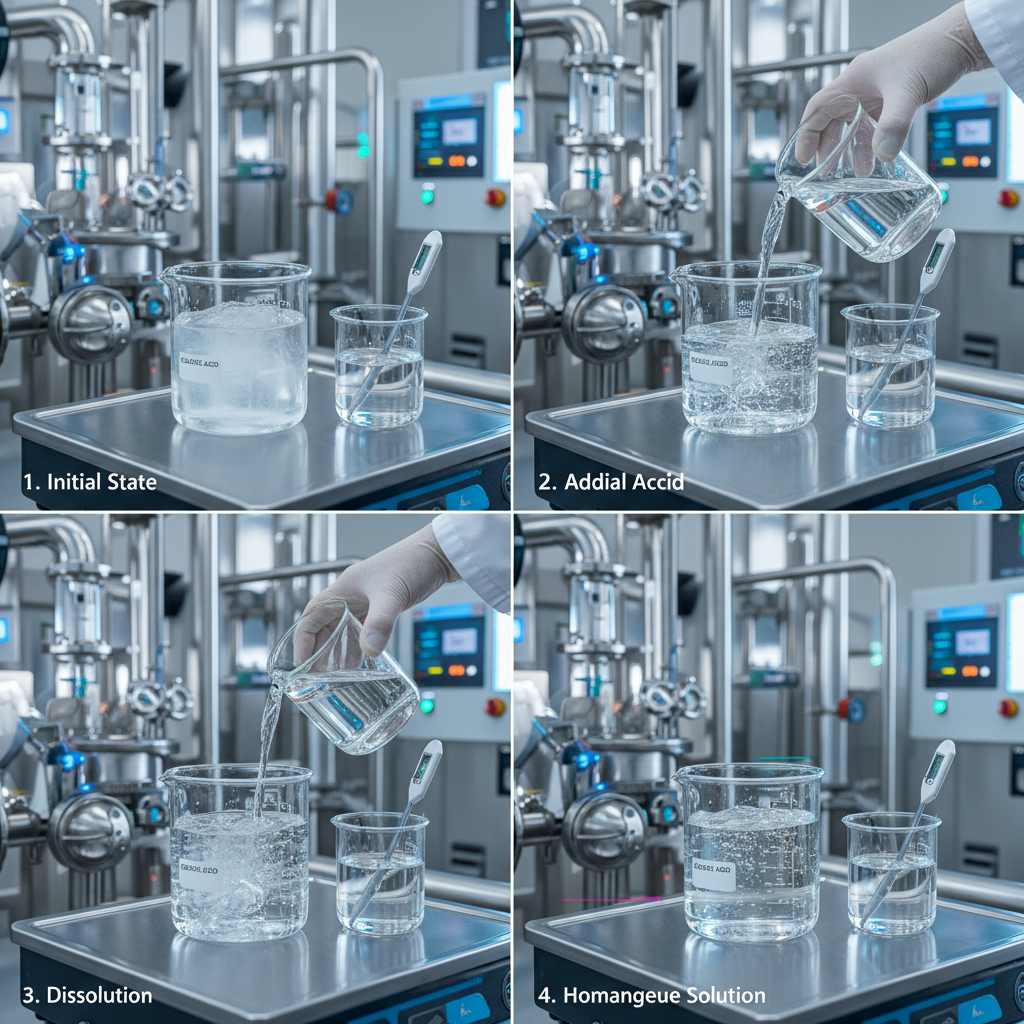
Glacial acetic acid is completely miscible with water. This means it can dissolve in water in any proportion, forming a homogeneous solution. This high solubility is due to the strong hydrogen bonding interactions between the acetic acid molecules and water molecules. The polar nature of both substances facilitates this interaction. However, the process of mixing glacial acetic acid and water is exothermic, meaning it releases heat. Therefore, it's crucial to add the acid to water slowly while stirring, never the other way around, to prevent splashing and potential hazards. The addition of water decreases the concentration of acetic acid and reduces the heat generated.
Factors Influencing Solubility:
• Strong hydrogen bonding between acetic acid and water.
• Polar nature of both substances.
• Exothermic reaction during mixing – heat release.
• Importance of adding acid to water slowly with stirring.
Temperature’s Impact on Solubility
While glacial acetic acid is miscible with water at all temperatures, the rate of dissolution is affected by temperature. Higher temperatures generally lead to a faster dissolution rate. However, the solubility itself doesn’t significantly change as it’s already completely miscible. The primary effect of temperature is on the viscosity of the solutions and the heat dissipation rate. A higher temperature reduces viscosity, making mixing easier. The exothermic nature of the dissolution process means that cooler water can absorb more heat, potentially leading to a slightly more stable solution during mixing.
Practical Applications and Safety Considerations
The complete miscibility of glacial acetic acid in water makes it incredibly useful in various applications. It’s used to prepare diluted acetic acid solutions for cleaning, pH adjustment, and as a reagent in analytical chemistry. In the food industry, it serves as a flavoring agent and preservative. However, due to its corrosive nature, safety is paramount. Always wear appropriate personal protective equipment (PPE), including gloves, goggles, and a lab coat, when handling glacial acetic acid. Ensure adequate ventilation to avoid inhaling fumes. Always add acid to water, never water to acid.

Product Specifications – YSXL Glacial Acetic Acid
YSXL Glacial Acetic Acid adheres to stringent quality standards. Here’s a typical specification sheet:
Conclusion: Harnessing the Solubility of Glacial Acetic Acid
Understanding the solubility characteristics of glacial acetic acid in water is essential for safe and effective handling across numerous applications. Its complete miscibility, coupled with the exothermic nature of the mixing process, requires careful consideration and adherence to safety protocols. YSXL Glacial Acetic Acid offers a reliable source of high-purity glacial acetic acid, supported by comprehensive specifications and a commitment to quality.
Frequently Asked Questions (FAQs)
Why does mixing glacial acetic acid and water generate heat?
The heat generated during mixing is due to the formation of new hydrogen bonds between the acetic acid and water molecules. These bonds release energy, manifesting as heat. This is an exothermic process. The stronger the interactions between the molecules, the more heat is released. This is a fundamental principle of solution thermodynamics. It’s vital to add the acid slowly to allow the heat to dissipate safely and prevent boiling or splashing.
What are the primary uses of diluted acetic acid solutions?
Diluted acetic acid solutions have numerous applications. They are frequently used in laboratories as a buffer solution for pH control. In household cleaning, they serve as a natural disinfectant and descaler. The food industry utilizes them as a flavoring agent, preservative, and in pickling processes. They are also employed in the textile industry for dyeing and finishing processes.
What safety precautions should be followed when handling glacial acetic acid?
Glacial acetic acid is corrosive and can cause severe burns. Always wear appropriate PPE, including chemical-resistant gloves, safety goggles, and a lab coat. Work in a well-ventilated area to avoid inhaling fumes. Add acid to water slowly, with continuous stirring, to manage the heat generated. Have readily available emergency equipment such as an eyewash station and safety shower. Always consult the Safety Data Sheet (SDS) before handling.
Can glacial acetic acid be used with all types of materials?
No, glacial acetic acid is corrosive and can react with certain materials. It’s incompatible with strong oxidizing agents, bases, and some metals. Avoid contact with materials such as aluminum, magnesium, and zinc. Use appropriate containers made from materials like glass or polyethylene for storage and handling. Always check for material compatibility before use.
-
Industrial Applications and Properties of 75 acetic acid Solution
NewsApr.16,2026
-
Properties and Industrial Applications of 64 19 7 acetic acid
NewsApr.09,2026
-
Comprehensive Guide to 56 Acetic Acid Applications and Reliable Sourcing
NewsApr.07,2026
-
Comprehensive Guide to 5 Glacial Acetic Acid for International Trade and Industrial Applications
NewsApr.04,2026
-
Exploring 100 Acetic Acid Properties Applications and Reliable Sourcing
NewsMar.31,2026
-
Comprehensive Guide to 10 Glacial Acetic Acid Properties and Applications
NewsMar.28,2026
 English
  Belarusian
  Dutch
Dutch  French
  German
  Hindi
Hindi  Indonesian
  Japanese
  Korean
  Lao
Lao  Malay
Malay  Mongolian
  Myanmar
  Polish
  Portuguese
  Russian
  Spanish
  Tagalog
  Thai
Thai  Vietnamese